📋 Table of Contents
What Is SIM Verification?
SIM verification in Pakistan is the process of confirming the identity of the person registered as the owner of a specific mobile SIM card. Every SIM card issued in Pakistan is legally required to be registered against a valid Computerized National Identity Card (CNIC), making it possible to trace any phone number back to its registered owner through official channels. This system was introduced as part of a nationwide effort to combat telecom fraud, terrorism financing through anonymous SIM cards, and mobile-related crimes.
In simple terms, when you or anyone else wants to know who owns a particular mobile number, SIM verification is the mechanism that provides that answer. The data is maintained by Pakistan's telecom regulator, the Pakistan Telecommunication Authority (PTA), along with individual telecom operators such as Jazz, Telenor, Zong, Ufone, and SCO. Platforms like SimOwner Details allow users to perform quick SIM ownership lookups using publicly available registration data.
SIM verification serves multiple purposes: it protects citizens from scam calls, helps businesses validate customer identities, assists law enforcement in investigations, and empowers individuals to check if any SIM cards have been fraudulently registered against their own CNIC. It is one of the foundational pillars of Pakistan's digital security infrastructure.
The PTA SIM Registration System
The Pakistan Telecommunication Authority (PTA) mandates that all mobile SIM cards be biometrically verified and registered. This regulation, which became fully enforced in 2015 under the SIM Re-verification Drive, requires every active SIM card to be linked to a valid CNIC holder whose biometric data (fingerprint) has been confirmed via NADRA's database. The result is one of the most robust national SIM registration systems in the developing world.
When a telecom company sells a new SIM card, the customer must present their original CNIC and provide a fingerprint scan at the point of sale. The telecom operator's system sends this biometric data in real time to NADRA (National Database and Registration Authority) for verification. Only after NADRA confirms a match between the fingerprint and the CNIC on record is the SIM card activated. This means no anonymous SIM cards can legally exist in Pakistan — every active number is tied to a real, verified identity.
The PTA also enforces limits on how many SIM cards can be registered per CNIC. Currently, a single individual can have a maximum of 5 active SIM cards on each network, with varying caps depending on the operator and plan type. These limits are designed to prevent bulk SIM acquisition for illegal purposes such as OTP fraud, spam calling, or mobile banking scams. You can explore the full details of SIM registration limits in our CNIC SIM Check guide.
How SIM Verification Works Step by Step
Understanding the actual process of SIM verification helps you appreciate both how effective the system is and what happens when you look up a mobile number. Here is the step-by-step breakdown:
Customer presents CNIC at a franchise or retailer. A fingerprint scan is taken on a biometric device provided by the telecom operator.
The fingerprint and CNIC number are sent to NADRA's central database in real time. NADRA confirms or rejects the match within seconds.
Upon NADRA confirmation, the telecom operator creates a registration record linking the mobile number to the verified CNIC and personal details.
The SIM is activated and the number becomes live. The registration data is stored in the operator's database and shared with PTA's central registry.
Citizens can verify SIM ownership via official PTA channels or third-party platforms like SimOwner search that query this registration data.
Methods of SIM Verification in Pakistan
There are several ways citizens can verify SIM card ownership in Pakistan, each suited to different scenarios and levels of detail required:
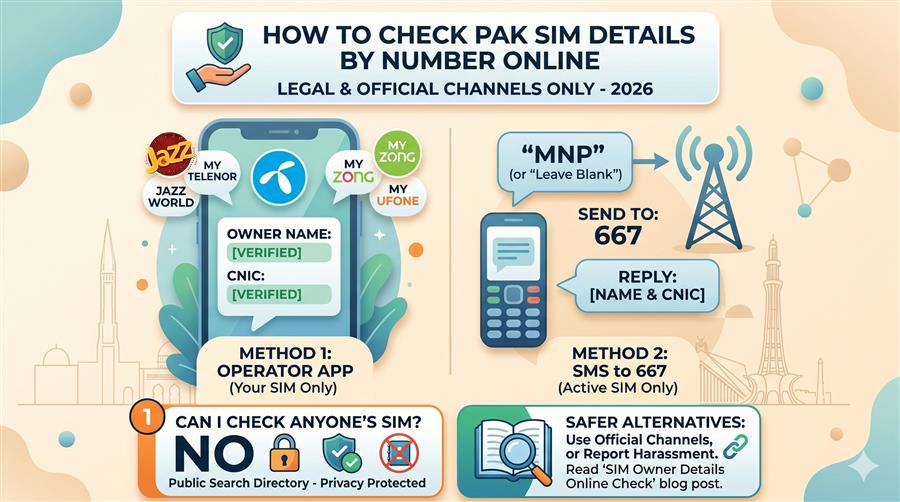
1. PTA Official SMS Service: The PTA provides an official SMS-based service where you can send your CNIC number to 668 (short code). In response, you receive a list of all active SIM cards registered against your CNIC across all networks. This is the most authoritative method and is completely free of charge. It is especially useful for individuals who want to check for unauthorized SIMs registered in their name.
2. Telecom Operator Customer Care: Each major telecom operator — Jazz (789), Telenor (345), Zong (310), Ufone (333), and SCO — has a dedicated customer care line. By calling and verifying your identity, you can ask for confirmation of which SIM cards are active on your account. This method gives operator-specific information rather than a cross-network view.
3. Online SIM Verification Portals: Platforms like SimOwner's SIM Information tool allow real-time lookup of SIM registration details. Users can enter a mobile number to retrieve the registered owner's name, CNIC prefix, and network operator information. These platforms are ideal for individuals, businesses, and researchers who need quick, accessible verification without going through official channels.
4. NADRA e-Services: NADRA offers a range of digital identity services through its e-Sahulat portal. While not directly a SIM verification tool, NADRA's systems underpin all biometric verification processes and can be accessed for identity-related queries by authorized institutions.
Who Can Verify a SIM Card?
SIM verification in Pakistan is accessible at different levels depending on the type of requester and the depth of information needed. Individual citizens can perform basic verification to check if their CNIC has been used to register unknown SIM cards. This right to check one's own registered SIMs is protected and promoted by the PTA as a consumer protection measure.
Businesses and organizations often need to verify mobile numbers during customer onboarding, loan applications, or employment background checks. Many financial institutions and fintech companies integrate SIM verification APIs into their Know Your Customer (KYC) processes to confirm that a customer's mobile number matches their registered identity. Law enforcement agencies, with appropriate judicial authorization, can request full SIM data from telecom operators through official channels. Our Pak SIM Data guide explains what specific information is accessible and to whom.
Common Uses of SIM Verification
The applications of SIM verification in everyday Pakistani life are broader than most people realize. The most common use case is fraud prevention: when someone receives a suspicious call from an unknown number, they can verify the owner to decide whether to engage or block the number. This has become critically important as phone scams have proliferated across Pakistan, with fraudsters impersonating bank officials, government employees, and even family members.
Another major use is business verification. When a small business owner receives an order from a new customer who pays via mobile wallet, verifying the phone number against registered ownership adds an extra layer of trust and security. Similarly, landlords, employers, and service providers routinely verify contact numbers before entering agreements. The SIM ownership data lookup helps all these stakeholders make informed decisions.
Personal security is another critical application. Many Pakistanis have discovered that their CNICs were used to fraudulently register multiple SIM cards — often by unscrupulous retailers or identity thieves. By periodically checking which SIMs are registered against their CNIC, citizens can detect and report such fraud before it leads to financial loss or legal complications.
Legal Framework & PTA Regulations
The legal basis for SIM verification in Pakistan rests on several key pieces of legislation and regulatory directives. The Pakistan Telecommunication (Re-organization) Act 1996 established the PTA as the primary regulatory authority for the telecom sector, giving it broad powers to set and enforce standards for SIM registration and consumer data management.
The Prevention of Electronic Crimes Act (PECA) 2016 further strengthened the legal framework by criminalizing the use of unauthorized or fraudulently registered SIM cards for illegal purposes. Under PECA, individuals found using SIM cards registered in another person's name without consent can face imprisonment and fines. The SIM Fraud Rules, issued by PTA in coordination with NADRA, specifically address the criminal acquisition and misuse of SIM cards, with penalties for retailers who issue SIMs without proper biometric verification.
From a consumer rights perspective, PTA regulations require all telecom operators to provide users with free access to information about SIMs registered on their CNIC. This is not merely a service — it is a legally mandated consumer protection right. If you believe unauthorized SIMs have been registered in your name, you can file a formal complaint with PTA through their online portal or helpline (0800-55055).
Privacy and Security Considerations
While SIM verification is a powerful tool for security and fraud prevention, it also raises legitimate privacy concerns that citizens should be aware of. When personal data — such as a CNIC number, registered name, and mobile number — is stored in centralized databases, there is always a risk of data breaches or unauthorized access. Pakistan's Personal Data Protection Bill (PDPB), which has been under consideration since 2021, aims to formalize protections for citizens' personal data, but the legislation is still evolving.
Responsible SIM verification platforms prioritize data minimization — returning only the information necessary for a given purpose (such as the registered owner's name and network) without exposing full CNIC numbers, addresses, or other sensitive details. When using any online SIM verification tool, it is important to choose platforms that are transparent about their data sources, adhere to PTA guidelines, and do not store your search queries or results without consent.
For personal protection, security experts recommend checking your CNIC's registered SIMs every few months via the PTA SMS service (send your CNIC to 668), especially if you have recently lost your CNIC card or suspect your identity may have been compromised. Visit our blog for more tips on protecting your digital identity in Pakistan.
Frequently Asked Questions
How can I check which SIMs are registered on my CNIC in Pakistan?
Send your 13-digit CNIC number (without dashes) as an SMS to 668. You will receive a reply listing all active SIM cards registered against your CNIC across all networks in Pakistan. This service is free and officially provided by PTA. You can also use our CNIC SIM Check tool for a quick online lookup.
Is SIM verification in Pakistan free?
The PTA's official SMS service (sending your CNIC to 668) is free of charge. Third-party platforms and some telecom operator value-added services may have associated costs. Always use officially recognized channels or reputable platforms for SIM verification.
Can I find the owner of any mobile number in Pakistan?
Yes, SIM registration data in Pakistan is linked to verified CNIC records, making it possible to identify the registered owner of any active mobile number. Tools like our SIM Owner Details page allow you to search by mobile number and retrieve the registered owner's information quickly.
What happens if someone registers a SIM using my CNIC without permission?
This is considered SIM fraud under PTA regulations and PECA 2016. You should immediately report it to PTA (0800-55055), file a complaint with the Federal Investigation Agency (FIA) Cybercrime Wing, and contact the telecom operator to have the unauthorized SIM blocked. The retailer who issued the SIM without proper verification can face serious penalties.
How many SIM cards can one CNIC have in Pakistan?
PTA currently allows a maximum of 5 SIM cards per network per CNIC. However, the total number across all networks is also subject to regulatory limits. If you try to purchase a new SIM but have reached your limit, the retailer's biometric system will reject the activation.
Is SIM verification data shared with law enforcement?
Yes, but only through legally prescribed channels. Law enforcement agencies such as the Police, FIA, and intelligence services can request SIM ownership data from telecom operators with appropriate legal authorization (such as a court order or government directive under applicable laws). Routine citizen queries do not expose this data to law enforcement.
Ready to Verify a SIM Card?
Use SimOwner's free tools to instantly check SIM ownership, CNIC-linked SIMs, and mobile number registration details in Pakistan.